Classes
Simple class with methods
Class declaration
class Parrot:

    # class attribute
    species = "bird"

    # instance attribute
    def __init__(self, name, age):
        self.name = name
        self.age = age

    # instance method
    def sing(self, song):
        return "%s sings %s" % (self.name, song)

    # instance method
    def dance(self):
        return "%s is now dancing" % (self.name)
Object use
# instantiate the Parrot class
blu = Parrot("Blu", 10)
woo = Parrot("Woo", 15)

# access the class attributes (same for any instance)
print("Blu is a", blu.__class__.species)
print("Woo is also a", woo.__class__.species)

# access the instance attributes (different for every instance)
print(blu.name, "is", blu.age, "years old")
print(woo.name, "is", woo.age, "years old")

# call our instance methods
print(blu.sing("'Happy'"))
print(blu.dance())
Output :
Blu is a bird
Woo is also a bird
Blu is 10 years old
Woo is 15 years old
Blu sings 'Happy'
Blu is now dancing
Inheritance
# parent class
class Bird:

    def __init__(self):
        print("Bird is ready")

    def whoisThis(self):
        print("Bird")

    def swim(self):
        print("Swim faster")

# child class
class Penguin(Bird):

    def __init__(self):
        # call super() function
        super().__init__()
        print("Penguin is ready")

    def whoisThis(self):
        print("Penguin")

    def run(self):
        print("Run faster")

peggy = Penguin()
peggy.whoisThis()
peggy.swim()
peggy.run()
Output :
Bird is ready
Penguin is ready
Penguin
Swim faster
Run faster
Encapsulation
Private variables
-> add double underscore prefix __
class Computer:

    def __init__(self):
        self.__maxprice = 900

    def sell(self):
        print("Selling Price: {}".format(self.__maxprice))

    def setMaxPrice(self, price):
        self.__maxprice = price

c = Computer()
c.sell()

# change the price
c.__maxprice = 1000
c.sell()    # direct change of __maxprice has no effect

# using setter function
c.setMaxPrice(1000)
c.sell()    # change through the setter has an effect
Output :
Selling Price: 900
Selling Price: 900
Selling Price: 1000
Note : when a name has two leading underscores (__), Python interpreter actually changes its name. For example, the name of the method __method from the ClassName class will be changed to _ClassName__method.
Therefore : use classInstance._className__privateVariable to access the private variable anyway
With previous example : c._Computer__maxprice
Protected variables
-> add a simple underscore prefix _
Those are accessible from the outside of the class, so there’s no “real” protection to prevent the user from accessing them
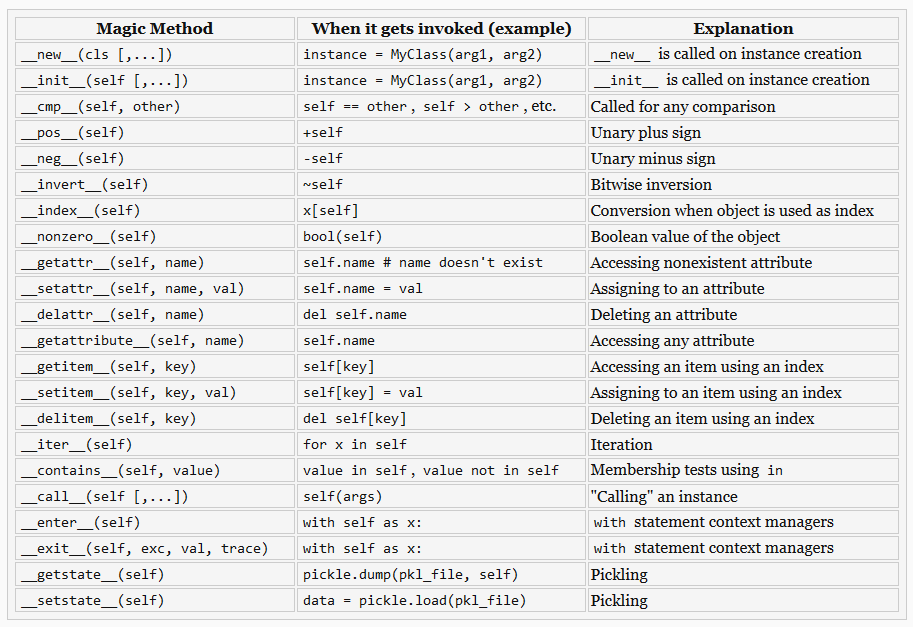
Special methods
__init__ : constructor
class Exemple:
    """Un petit exemple de classe"""
    def __init__(self, nom):
        """Exemple de constructeur"""
        self.nom = nom
        self.autre_attribut = "une valeur"
__del__ : object destructor
Defines what happends when the object is destructed with the del keyword
Could lead to memory leakages : potentially messes up the garbage collection
def __del__(self):
        """Méthode appelée quand l'objet est supprimé"""
        print("C'est la fin ! On me supprime !")
__repr__ : object representation
Defines what is returned when we simply call the object. Example :
class Personne:
    """Classe représentant une personne"""
    def __init__(self, nom, prenom):
        """Constructeur de notre classe"""
        self.nom = nom
        self.prenom = prenom
        self.age = 33
    def __repr__(self):
        """Quand on entre notre objet dans l'interpréteur"""
        return "Personne: nom({}), prénom({}), âge({})".format(
                self.nom, self.prenom, self.age)
>>> p1 = Personne("Micado", "Jean")
>>> p1
Personne: nom(Micado), prénom(Jean), âge(33)
>>>
__getattr__ : called when an non-existent attribute is set
class Protege:
    """Classe possédant une méthode particulière d'accès à ses attributs :
    Si l'attribut n'est pas trouvé, on affiche une alerte et renvoie None"""

    def __init__(self):
        """On crée quelques attributs par défaut"""
        self.a = 1
        self.b = 2
        self.c = 3
    def __getattr__(self, nom):
        """Si Python ne trouve pas l'attribut nommé nom, il appelle
        cette méthode. On affiche une alerte"""
        print("Alerte ! Il n'y a pas d'attribut {} ici !".format(nom))
>>> pro = Protege()
>>> pro.a
1
>>> pro.c
3
>>> pro.e
Alerte ! Il n'y a pas d'attribut e ici !
>>>
__setattr__ : redefines the way an attribute is set
class MyClass:

    def __init__(self):
        self.foo = 0

    def __setattr__(self, attr_name, attr_value):
        if attr_value < 0:
            print("wrong value")
        else:
            object.__setattr__(self, attr_name, attr_value)
Note : it is necessary to specify object.__setattr__ to avoid creatung an infinite loop (__setattr__ -> __setattr__ -> __setattr__…)
>>> c = MyClass()
>>> c.foo = -5
wrong value
>>> print(c.foo)
0
>>> c.foo = 65
>>> print(c.foo)
65
>>>
__delattr__ : delete an attribute
del objet.attribut doesn’t work -> use object.__delattr__ instead
def __delattr__(self, nom_attr):
    """On ne peut supprimer d'attribut : on lève l'exception AttributeError"""
    raise AttributeError("Vous ne pouvez supprimer aucun attribut de cette classe")
Container (lists, dictionaries, strings…) methods
__getitem__
Called to get container[i]
class ZDict:

    """Classe enveloppe d'un dictionnaire"""

    def __init__(self):
        """Notre classe n'accepte aucun paramètre"""
        self._dictionnaire = {}

    def __getitem__(self, index):
        """Cette méthode spéciale est appelée quand on fait objet[index]
        Elle redirige vers self._dictionnaire[index]"""
        return self._dictionnaire[index]
__setitem__
Called to set container[i]
class ZDict:

"""Classe enveloppe d'un dictionnaire"""

    def __init__(self):
        """Notre classe n'accepte aucun paramètre"""
        self._dictionnaire = {}

    def __setitem__(self, index, valeur):
    """Cette méthode est appelée quand on écrit objet[index] = valeur
    On redirige vers self._dictionnaire[index] = valeur"""
    self._dictionnaire[index] = valeur
__delitem__
Called to delete container[i]
class ZDict:

"""Classe enveloppe d'un dictionnaire"""

    def __init__(self):
        """Notre classe n'accepte aucun paramètre"""
        self._dictionnaire = {}

    def __delitem__(self):
        """Cette méthode est appelée quand on écrit del objet[index]"""
        print("Item deleted !")
__contains__
Called when using in keyword
ma_liste = [1, 2, 3, 4, 5]
# This :
8 in ma_liste
# ...is the same as :
ma_liste.__contains__(8)
Overloading mathematical operators
Classic operators
| Operation | Syntax | Function |
|---|---|---|
| Addition | a + b |
add(a, b) |
| Concatenation | seq1 + seq2 |
concat(seq1, seq2) |
| Containment Test | obj in seq |
contains(seq, obj) |
| Division | a / b |
truediv(a, b) |
| Division | a // b |
floordiv(a, b) |
| Bitwise And | a & b |
and_(a, b) |
| Bitwise Exclusive Or | a ^ b |
xor(a, b) |
| Bitwise Inversion | ~ a |
invert(a) |
| Bitwise Or | a | b |
or_(a, b) |
| Exponentiation | a ** b |
pow(a, b) |
| Identity | a is b |
is_(a, b) |
| Identity | a is not b |
is_not(a, b) |
| Indexed Assignment | obj[k] = v |
setitem(obj, k, v) |
| Indexed Deletion | del obj[k] |
delitem(obj, k) |
| Indexing | obj[k] |
getitem(obj, k) |
| Left Shift | a << b |
lshift(a, b) |
| Modulo | a % b |
mod(a, b) |
| Multiplication | a * b |
mul(a, b) |
| Matrix Multiplication | a @ b |
matmul(a, b) |
| Negation (Arithmetic) | - a |
neg(a) |
| Negation (Logical) | not a |
not_(a) |
| Positive | + a |
pos(a) |
| Right Shift | a >> b |
rshift(a, b) |
| Slice Assignment | seq[i:j] = values |
setitem(seq, slice(i, j), values) |
| Slice Deletion | del seq[i:j] |
delitem(seq, slice(i, j)) |
| Slicing | seq[i:j] |
getitem(seq, slice(i, j)) |
| String Formatting | s % obj |
mod(s, obj) |
| Subtraction | a - b |
sub(a, b) |
| Truth Test | obj |
truth(obj) |
| Ordering | a < b |
lt(a, b) |
| Ordering | a <= b |
le(a, b) |
| Equality | a == b |
eq(a, b) |
| Difference | a != b |
ne(a, b) |
| Ordering | a >= b |
ge(a, b) |
| Ordering | a > b |
gt(a, b) |
Inplace Operators
| Function | Equivalent |
|---|---|
a = iadd(a, b) |
a += b |
a = iand(a, b) |
a &= b |
a = iconcat(a, b) |
a += b for a and b sequences |
a = ifloordiv(a, b) |
a //= b |
a = ilshift(a, b) |
a <<= b |
a = imod(a, b) |
a %= b |
a = imul(a, b) |
a *= b |
a = imatmul(a, b) |
a @= b |
a = ior(a, b) |
a |= b |
a = ipow(a, b) |
a **= b |
a = irshift(a, b) |
a >>= b |
a = isub(a, b) |
a -= b |
a = itruediv(a, b) |
a /= b |
a = ixor(a, b) |
a ^= b |
Pickles specific methods
__getstate__
Returns the object to be serialized by pickle. If it’s not defined, the object is serialized as is. __getstate__ allows to modify it before serializing it:
class Temp:
    """Classe contenant plusieurs attributs, dont un temporaire"""

    def __init__(self):
        """Constructeur de notre objet"""
        self.attribut_1 = "une valeur"
        self.attribut_2 = "une autre valeur"
        self.attribut_temporaire = 5

    def __getstate__(self):
        """Renvoie le dictionnaire d'attributs à sérialiser"""
        dict_attr = dict(self.__dict__)
        dict_attr["attribut_temporaire"] = 0
        return dict_attr
Here the attribut_temporaire attribute is set to zero beforethe object is serialized.
__setstate__
Called when the object is deserialized by pickle
...
    def __setstate__(self, dict_attr):
        """Méthode appelée lors de la désérialisation de l'objet"""
        dict_attr["attribut_temporaire"] = 0
        self.__dict__ = dict_attr
see POP307 for more serialization linked methods